

How to Write a Birth Plan: What to Include & How to Use It
By the Nurtured Nest Team · Trusted by UNC Health Rex & 3,000+ families · A program of The Nurture to Bloom Foundation, a 501(c)(3) nonprofit
A birth plan is a short summary of your preferences for labor, delivery, and the first hours with your baby — usually about a page long. It isn't a contract or a script. It's a way to think through your options before you're in the moment, and a non-confrontational way to let your care team know what matters most to you.
Below you'll find what to include, how to use your plan with your care team, and what to do if labor takes a different path — so you and your support person walk in on the same page.
How to write a birth plan: keep it to one page, lead with your top two or three priorities, and review it with your provider before labor. Here's the short version:
- What to includeLabor comfort, monitoring, pushing, cesarean preferences, and newborn care
- When to write itAround 28–32 weeks, so there's time to review it
- Who sees itYour provider, your support person, and your nurse at intake
- If plans changeAdd a short "flex plan" for what still matters most
Keep reading for a full checklist, the B.R.A.I.N. decision tool, a simple script for intake, and how to split up support roles.
Jump to: Why it helps · What to include · B.R.A.I.N. tool · Flex plan · How to use it · Two-or-three rule · Putting it together · FAQs
Why a Birth Plan Helps
Labor moves quickly, and it's hard to weigh options calmly while you're in active labor or meeting your baby for the first time. Thinking through your preferences ahead of time means fewer decisions to make under pressure and a support person who already knows what you'd want.
It also helps even when birth doesn't follow the plan. Parents who've talked through their priorities in advance often feel more steady and more heard, because the people around them already understand what matters most.
What to Include in a Birth Plan
A good plan covers the full arc of birth — from labor preferences to the first moments after delivery — and stays short enough for a nurse to read in about 90 seconds.

During labor
- Comfort measures and pain management (including epidural timing)
- Movement and position preferences
- Monitoring (continuous vs. intermittent)
- IV, fluids, and hep-lock preferences
- Who you want in the room, and when
Delivery & just after
- Pushing preferences (coached vs. breathing down)
- Cesarean preferences if needed (skin-to-skin, partner presence)
- Cord clamping preferences
- Skin-to-skin and the golden hour
- Newborn care (vitamin K, eye ointment, bath, feeding)
Your hospital stay
- Rooming-in preferences
- Feeding plans and support you'd like
- Visitors and quiet time
Going home
- Who's helping in the first weeks
- What you and your partner expect postpartum
- Rest, meals, and recovery support
The B.R.A.I.N. Tool: Five Questions for Any Decision
When something comes up during labor that isn't in your plan, these five questions help you and your support person talk it through with your care team:
Benefits: What are the benefits?
Risks: What are the risks?
Alternatives: What else could we try?
Intuition: What does my gut say?
Nothing: What if we wait or do nothing for now?
How to Use Your Birth Plan
The plan is only as useful as what you do with it. This is the sequence that tends to work.
Fill it in around 28–32 weeks
Early enough to review with your provider, late enough that your preferences are informed. Starting later? Still useful — just move a little faster.
Review it at a prenatal visit
Ask your OB or midwife what aligns with how their practice works and what might look different. Some preferences vary by hospital — better to know now.
Brief your support person
Give them the two or three things that matter most. If there's a shift change during labor, they're the ones who'll re-introduce your preferences to a new nurse.
Keep it to one page and pack two copies
Mark your top priorities clearly; that's what gets followed. One copy for you, one for your chart. Email it to your provider before your due date if you can.
"We made a birth plan, and we know things can change — but these two things matter most to us."
Naming your top two makes your plan memorable and starts a conversation, rather than hoping a document gets read. Most labor and delivery nurses want to support your preferences when they can.
Our Approach: The Two-or-Three Rule

If there's one idea we come back to, it's this: a birth plan works best when it leads with the few things that matter most to you, and leaves room to navigate the rest in the moment. The best birth plans aren't the longest ones. They clearly communicate two or three things that really matter to this family — and stay flexible about the rest.
Give Your Support People a Job
Most support people want to help and just aren't sure how — so a loose role can make a real difference.
Role 1
Comfort
Positions and movement, counter-pressure, breathing cues, water and cold cloths.
Role 2
Communication
Reminding staff of priorities, asking questions, re-introducing the plan at shift changes.
Role 3
Logistics
Tracking progress, managing the room and visitors, updates to family, keeping the plan visible.
Want Help Putting It All Together?
You now know what goes into a birth plan, how to make decisions in the moment, and how to share it with your care team. The hard part is sitting down and actually working through it — especially with a partner.
That's a lot to think through
Want us to walk you through all of it?
Our Birth Planning Guide does the heavy lifting. This guided workbook takes you and your support person through every decision in this article — then helps you turn it into one clear page for the hospital. It works whether you're planning an epidural, an unmedicated birth, or haven't decided yet.
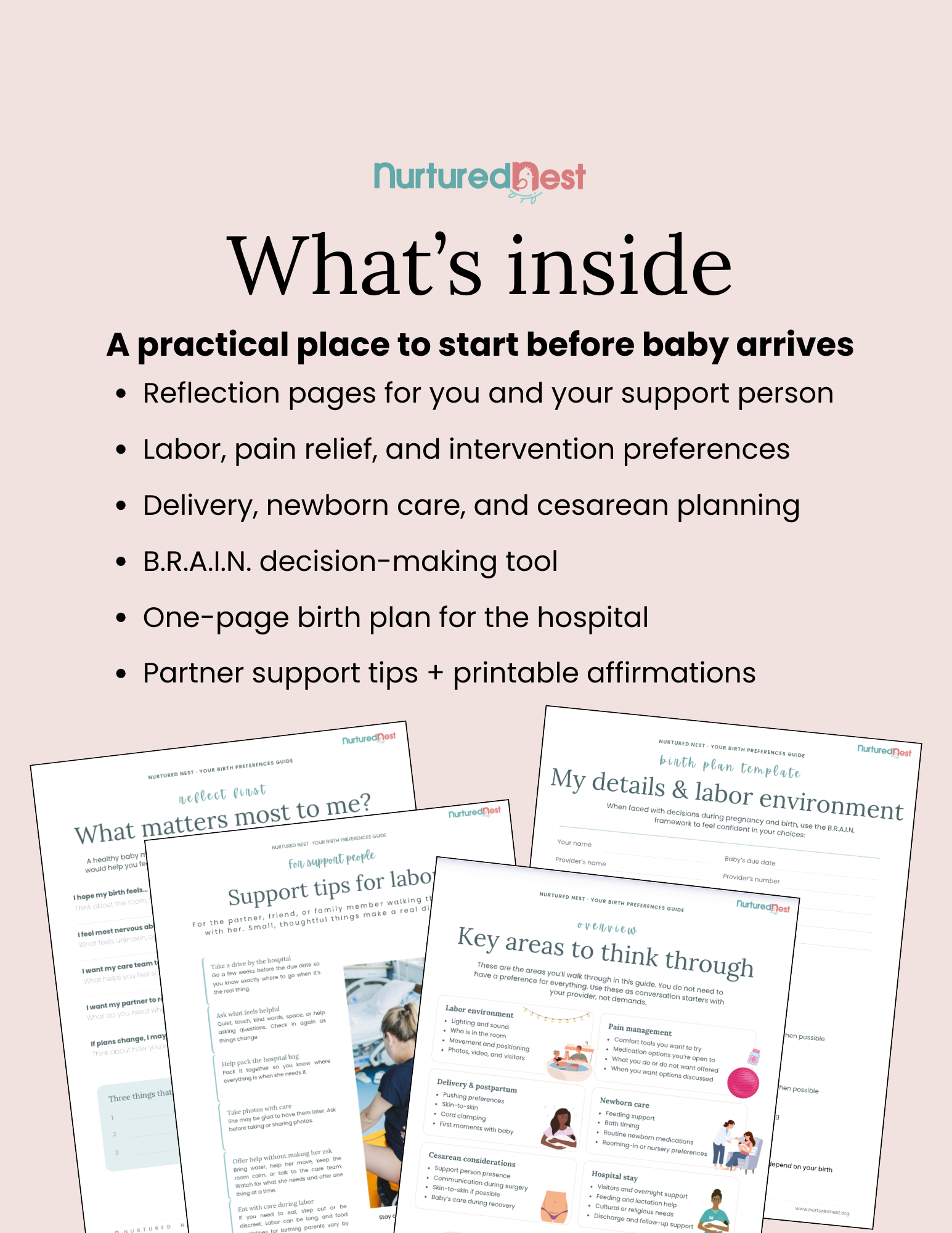
23-page digital PDF · Instant access after checkout · Share it with your partner or doula
A Blank Template vs. the Birth Planning Guide
A blank template asks you to check boxes. The guide helps you figure out what to put in them.
| Blank template | Birth Planning Guide | |
|---|---|---|
| One-page summary for the hospital | ✓ | ✓ |
| Explains your options as you go | — | ✓ |
| Reflection pages for your partner | — | ✓ |
| B.R.A.I.N. tool for decisions in the moment | — | ✓ |
| Cesarean and postpartum planning | — | ✓ |
| Affirmation cards and visualization ideas | — | ✓ |
Ready to Go Beyond the Plan?
A birth plan captures your preferences. Understanding the options behind them is what makes those preferences feel like your own.
From the Nurtured Nest learning platform
Like having resources that help you think through every part?
That's what our full Childbirth + Postpartum Program does best. Expert-led lessons explain what's actually happening at each stage — pain management, induction, cesarean birth, partner support, recovery, and more — with guides and checklists like this one built in, so every choice in your plan is an informed one.
- Partner access included
- 52 short lessons
- Questions answered in 24 hours
Feeling reasonably prepared and very well informed about all options, without pressure to choose one method as best.
Birth Plan FAQ
When should I write my birth plan?
Around 28–32 weeks is a comfortable window — early enough to review it with your provider at a prenatal visit, late enough that you've thought through your options. If you're further along, start now; an unfinished plan with your top priorities noted is still useful.
What if I don't know what I want yet?
That's very common, and it's exactly what the Birth Planning Guide is designed to help with. It walks through the common areas to consider and gives you questions to discuss with your care team, so you can decide one step at a time.
What if my birth doesn't go according to plan?
That's common, which is exactly why a short "flex plan" note helps. The goal isn't to control what happens; it's to know what still matters if the path changes. Someone planning an unmedicated birth who ends up needing a cesarean can still have preferences about who's in the room, whether they watch the birth, and skin-to-skin in recovery.
Will the hospital actually follow my birth plan?
Many preferences — skin-to-skin, delayed cord clamping, who's in the room, asking before procedures — are honored routinely. Others depend on your hospital's policies and what's happening clinically. The best way to know what to expect is to review your plan with your provider before you're in labor.
Do I need a birth plan if I'm planning an epidural?
It can still help. An epidural doesn't mean fewer decisions — just different ones. Your plan can cover when you'd like to be offered the epidural, what you want during pushing, delivery preferences, and newborn care. The Birth Planning Guide covers medicated and unmedicated births alike.
Can my partner use the guide too?
Yes. The Birth Planning Guide includes a separate reflection page for your partner or support person, with prompts for comparing notes — and you can share the PDF with your partner or doula.
Ready to write yours?
Two ways to get ready
Birth Planning Guide
For couples who want to finish their birth plan this week.
$17
- 23-page guided workbook
- Partner reflection pages and the B.R.A.I.N. tool
- One-page hospital summary
Childbirth + Postpartum
For couples who want to understand every choice — not just list it.
$199
- 52 short lessons · 5+ hours · 22 guides
- Partner access and questions answered in 24 hours
- 12 months of access
Preparing for the whole first year? See the Complete Pregnancy to Baby Bundle.
