

Labor Positions in a Hospital Bed: What Actually Works With an Epidural
By the Nurtured Nest Team · Trusted by UNC Health Rex & 3,000+ families · A program of The Nurture to Bloom Foundation, a 501(c)(3) nonprofit
The most common worry we hear from people planning a hospital birth: "I'm going to be stuck flat on my back the whole time." If you end up with an epidural, continuous monitoring, or both, it's a reasonable thing to worry about.
Here's the good news: even in a hospital bed, even with an epidural, you have more options than you think. The positions you use still matter, for comfort, for progress, and for how you experience your birth. This guide covers the in-bed positions that work, the one tool most people don't know to ask for, how to push from the bed, and exactly what to say to your nurse.
The best labor positions in a hospital bed, especially with an epidural:*
- Ask for firstPeanut ball side-lying, as soon as your epidural is in
- Sit upThrone position: bed raised, knees apart, for gravity and comfort
- Keep changingSwitch sides about every 30–45 minutes, with help
- For pushingThrone, side-lying, or tug-of-war, not flat on your back
*General education, not medical advice. Your nurse and anesthesiologist will guide what's safe with your epidural.
Not planning an epidural, or able to move freely? See Hospital Birth Positions: 12 That Actually Work for standing, walking, ball, and toilet positions by phase.
Jump to: Why it matters · What you can do with an epidural · In-bed positions · The peanut ball · Pushing from bed · What to ask your nurse · At a glance · FAQs
Why Your Position in Bed Still Matters
Lying flat on your back, the classic labor image, is one of the least helpful positions for most people. It takes gravity out of the picture, and lying flat can press on major blood vessels, which is why your nurse may tilt you to one side.*
The goal in bed is to keep your pelvis open, tilted, and changing. Small adjustments count: a raised bed, a pillow under one hip, a peanut ball between your knees. You don't need to stand or walk for positioning to help. Shifting regularly gives baby room to move down and rotate.
*General education, not medical advice. Your care team will tell you if there's a reason you need a particular position.
What You Can (and Can't) Do With an Epidural
Usually possible
- Lying on either side, with pillows or a peanut ball
- Sitting upright with the bed raised
- Changing positions every 30–45 minutes, with help
- Some kneeling or squat bar support, if your legs have enough strength
Usually not possible
- Walking or standing on your own
- Getting in and out of bed without help
- Repositioning alone (always ask your nurse or partner)
How much you can move depends on your epidural's dose and how your body responds. Some hospitals offer a lower-dose epidural that may leave more feeling and movement. It's worth asking about ahead of time.*
*General education, not medical advice. Ask your anesthesiologist what your epidural allows.
In-Bed Labor Positions: Your Full Menu
Each position is tagged so you can see at a glance whether it works with an epidural, for rest, or for pushing.

Peanut Ball Side-Lying
A peanut-shaped ball goes between your knees while you lie on your side. It keeps your pelvis open and uneven, a bit like movement does, even when you can't move on your own. Switch sides about every 30–45 minutes.
Throne / Semi-Sitting (Upright in Bed)
Raise the head of the bed high and sit upright with your knees comfortably apart. You get some help from gravity while staying fully supported, and it's easy to monitor. It works through active labor and is a common pushing position too.
Side-Lying (Alternating)
Plain side-lying, with pillows between your knees and under your belly, is good for rest and keeps pressure off your back. The key is switching sides. Staying on one side too long may slow things down.
Supported Hands & Knees (Kneeling on Bed)
If your epidural is light enough to bear some weight, you can kneel on the bed and rest your forearms on the raised head of the bed. It's especially helpful for back pain. Ask your nurse and anesthesiologist first.
Back pain is the main problem? See Back Labor Positions: What Actually Helps.
Tug-of-War (for Pushing)
Hold one end of a knotted sheet or towel while your partner holds the other. During pushing contractions, pull while they hold firm. It gives your body something to push against, which helps when you can't clearly feel the urge to push.

Squat Bar (Partial Weight-Bearing)
Many hospital beds have a squat bar that attaches across the bed. If your epidural allows some weight-bearing, you can hold the bar and shift into a supported semi-squat during contractions.
The Peanut Ball: The One Thing Most People Don't Know to Ask For
If you remember one thing from this post, make it this: ask for a peanut ball when your epidural is placed.
A peanut ball is a peanut-shaped exercise ball that sits between your knees while you lie on your side. It holds your pelvis partly open without any effort from you. Several studies suggest it may help shorten labor for people with epidurals; findings on whether it lowers cesarean rates are mixed.* Either way, it's low-effort and easy to ask for.
Three things to remember (or hand to your partner)
- Ask for it right away when the epidural goes in, not hours later
- Place it between your knees while you lie on your side, top knee bent slightly forward over the ball
- Switch sides about every 30–45 minutes. Set a timer; your nurse or partner helps you turn
*General education, not medical advice. Your nurse can tell you whether a peanut ball is available and right for you.
Pushing From a Hospital Bed: What Actually Helps
Most hospital pushing happens in bed, and your position in the bed still matters.
Avoid flat on your back
Lying flat with legs in stirrups is convenient for providers but isn't the most helpful position for most people. Ask for the head of the bed to be raised.
Make the throne your default
Semi-sitting with the bed raised and knees apart is effective, easy for nurses to work with, and sustainable through a long pushing stage.
Try side-lying pushing
Lying on your side with someone supporting your top leg is underused. It can help when you need to rest or when baby needs to rotate.
Pull against something
Tug-of-war or the squat bar helps your body engage the right muscles when an epidural makes the urge to push hard to feel. Your nurse can also coach you on timing with the monitor.
What to Ask Your Nurse When You Arrive
Ask early, before the epidural and before active labor, while you can still think clearly.
About monitoring
"What kind of monitoring will I have? Is wireless monitoring an option?"
Before the epidural
"Do you have a peanut ball I can use once my epidural is in?"
Before pushing
"Can we attach the squat bar now, so it's ready?"
All labor long
"Is it okay if my partner helps me switch sides every 30–45 minutes?"
"If I get an epidural, I'd like to keep changing positions. Can we use a peanut ball and switch sides regularly, and can I push sitting up or on my side?"
Specific requests land better than vague ones. If you're told to stay in one position, it's always okay to ask why.
At a Glance: In-Bed Labor Positions
| Position | Epidural OK? | Best for | Switch timing |
|---|---|---|---|
| Peanut ball side-lying | Yes | Active labor, rest | Every 30–45 min |
| Throne / semi-sitting | Yes | Active labor, pushing | As needed |
| Side-lying (alternating) | Yes | Rest, active labor | Every 30–45 min |
| Supported hands & knees | Partial | Back pain, rotation | As tolerated |
| Tug-of-war | Yes | Pushing | Each contraction |
| Squat bar | Partial | Pushing | Each contraction |
That's a lot to remember
Want us to walk you through all of it?
Our Labor Positions Guide puts 12 photographed positions in one place, including epidural-friendly and peanut ball options, plus early labor, rest, back labor, and pushing. Each one shows how to do it and exactly what your support person should do. Save it to your phone or print it for your hospital bag.
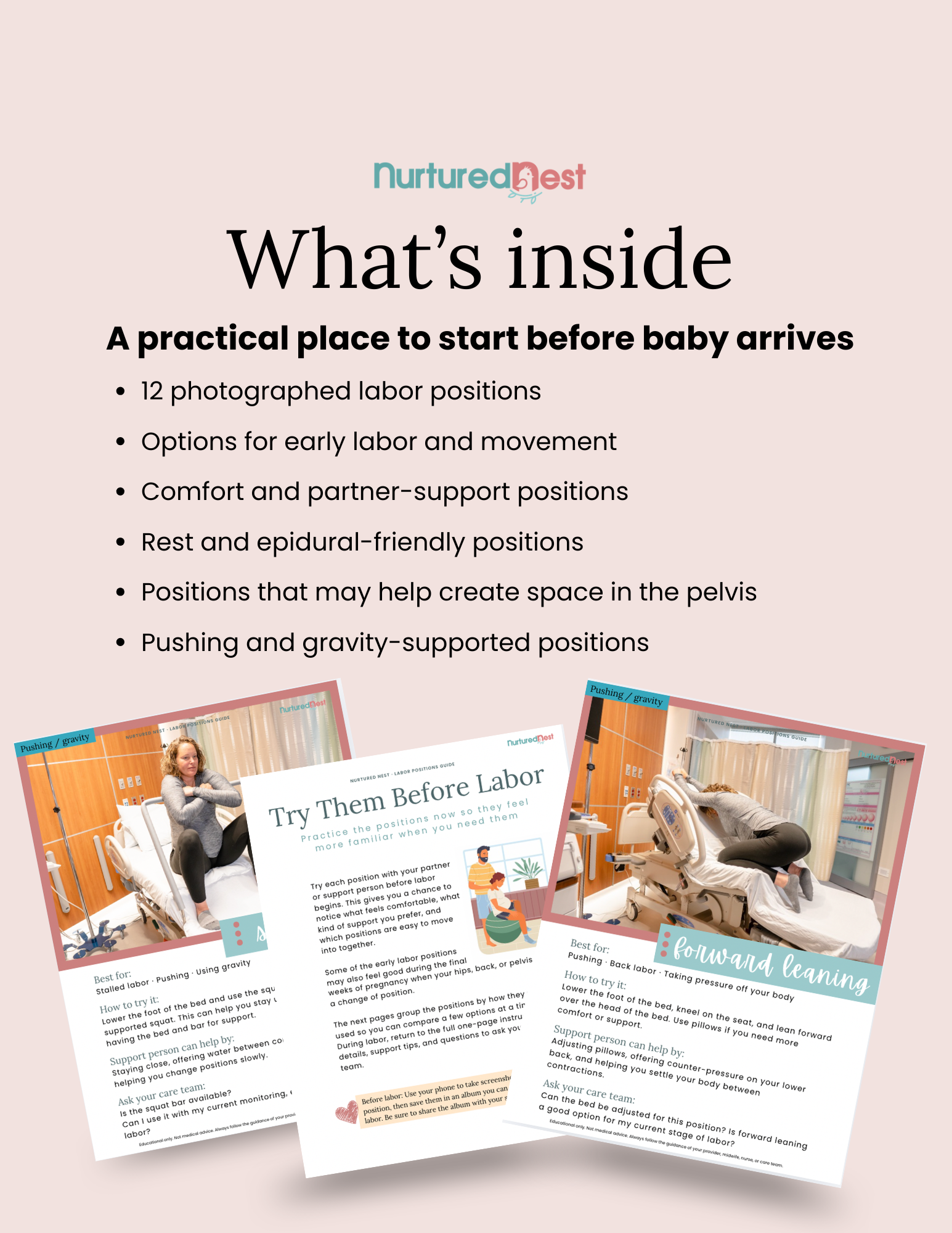
18-page digital PDF · Instant access after checkout · Share it with your partner or doula
Wondering how an epidural fits your birth plan, or what your hospital usually offers? Nurtured Nest families can send a question through the platform or by email, and the educator or expert whose background best fits the topic replies within 24 hours. We'll help you understand your options and prepare questions for your care team.
From the Nurtured Nest learning platform
Like having resources like this that help you think through every part?
That's what our full Childbirth + Postpartum Program does best. Expert-led lessons cover pain relief and epidurals, in-bed and upright positions, pushing, the partner's role, and what to do when birth doesn't go as planned, with guides and checklists built in. Watch on your own schedule, rewatch closer to your due date, and send a question any time during your access.
- Partner access included
- 52 short lessons
- Questions answered in 24 hours
Before watching, I felt very underprepared and a little terrified of labor and delivery. After finishing the course, I feel way more confident and now have an arsenal of tools to help.
Labor Positions With an Epidural: FAQ
Do I have to lie flat on my back with an epidural?
No. This is one of the most common myths about epidural births. You usually can't walk or stand, but you can use in-bed positions that keep your pelvis open: peanut ball side-lying, the throne position, side-lying with regular switches, and tug-of-war for pushing.*
Which labor positions work best with an epidural?
Peanut ball side-lying is the one to ask for first. Sitting upright in the throne position, side-lying with switches every 30–45 minutes, and butterfly with pillows under your knees also work well, since none of them need much independent movement. If your epidural allows some weight-bearing, supported kneeling or the squat bar may be options too.*
What if my epidural is strong and I can't feel anything?
A strong epidural limits some options, but peanut ball side-lying, side switching, and the throne position work regardless of how much you feel. For pushing, tug-of-war helps when you can't feel the urge, and your nurse can coach your pushes using the monitor.*
Can I ask for a lighter epidural so I can move more?
Yes, it's reasonable to ask. Some hospitals offer a lower-dose epidural (sometimes called a "walking epidural") that may leave more feeling and movement. Not every hospital offers it, and it isn't right for every situation, so ask your anesthesiologist ahead of time.*
How do I switch sides with an epidural?
Always with help. Your nurse or partner helps you turn while keeping the monitor and epidural line in place. It takes about a minute. Tell your nurse early that you'd like to switch sides regularly.
Does the peanut ball actually help?
Several studies suggest the peanut ball may help shorten labor for people with epidurals, and it's easy to ask for. Research on whether it lowers cesarean rates is mixed. If your hospital has one, it's a simple, low-effort thing to try.*
What if I'm told I have to stay in bed?
It's always okay to ask why. Sometimes there's a clear medical reason. Either way, you still have options in bed: side-lying with a peanut ball, the throne position, butterfly, and regular position changes.
*General education, not medical advice. Your nurse and anesthesiologist will guide what's safe for you.
Ready for labor day?
Two ways to get ready
Labor Positions Guide
For couples who want a quick, visual plan for labor day.
$9
- 12 photographed positions, including epidural-friendly options
- Support-person steps for every position
- Printable and phone-ready
Childbirth + Postpartum
For couples who want to understand all of labor, including pain relief and epidurals.
$199
- 52 short lessons · 5+ hours · 22 guides
- Partner access and questions answered in 24 hours
- 12 months of access
15-day money-back guarantee · Eligible purchases may be reimbursable through an HSA or FSA · Preparing for the whole first year? See the Complete Pregnancy to Baby Bundle.
