

Back Labor Positions: What Actually Helps When It Hurts Most
By the Nurtured Nest Team · Trusted by UNC Health Rex & 3,000+ families · A program of The Nurture to Bloom Foundation, a 501(c)(3) nonprofit
If you're reading this because your back is already screaming — or because you want to be prepared in case it does — you're in the right place. Back labor is real, it's more common than most people expect, and there are specific things that help.
This guide gives you the positions, the techniques, and the partner instructions, so you're not trying to figure it out in the middle of the hardest part of labor.
What helps back labor: get off your back, lean forward, and have your partner press firmly on your lower back during contractions.
- Try firstHands & knees: the position with the best evidence for easing back pain
- Standing upLean forward onto your partner, the bed, or a wall
- Partner's jobFirm counter-pressure on the sacrum during every contraction
- With an epiduralSide-lying with a peanut ball, switching sides often
- Add to anythingHeat between contractions; cold during them if heat isn't helping
Keep reading for exactly how each position works and what your partner should do.
Watch: A Back Labor Lesson
See what back labor relief looks like in real life, from our Childbirth + Postpartum program.
A lesson from Nurtured Nest's Childbirth + Postpartum program
Jump to: Watch the lesson · What is back labor · The positions · Counter-pressure · Heat & cold · With an epidural · Quick reference · Your labor-day playbook · FAQs
What Is Back Labor, and Why Does It Happen?
Back labor is intense, persistent pain in the lower back during contractions, and often between them. Unlike typical contraction pain that peaks and fades, back labor can feel relentless, especially in active labor.
The most common cause is a posterior position: baby is facing up (occiput posterior, or "OP") instead of facing your back. In this position, the back of baby's head presses against your sacrum during contractions, which creates that deep, grinding lower back pain.
Back labor can also happen when baby isn't posterior. Pelvic shape, baby's angle, and your own anatomy all play a role. The techniques below can help either way.
Back Labor Positions: What Actually Helps
Hands & Knees (All-Fours)
This is the position most doulas and midwives reach for first with back labor. Getting onto all fours takes baby's weight off your sacrum and may give baby more room to turn. It also has the best research behind it: in a Cochrane review, people who spent time on hands and knees during labor reported less back pain. (Hunter et al., 2007)
You can do it on a floor mat, on a hospital bed (kneeling and leaning onto the raised head of the bed), or with your forearms resting on a birth ball.
Forward-Leaning Inversion
Kneel on the bed or a firm surface and lower your forearms in front of you, like a supported child's pose. This gently tips the pelvis and may give a posterior baby room to turn. Use short holds only (30–60 seconds), then rest. This one hasn't been well studied, so ask your nurse or provider before trying it.
It's not for everyone or every birth, but if baby seems stuck facing up or labor has stalled, it's worth having in your toolkit.
Standing Lean-Forward
Stand and lean forward against your partner, the raised hospital bed, or a wall. Leaning forward keeps baby's weight off your sacrum, and standing keeps gravity on your side. It's the standing version of hands and knees, and many people find it easier to keep up during a long active labor.
Supported Squat / Squat Bar
Squatting opens the pelvic outlet and encourages baby to move down. Squat during contractions, then rest standing or sitting between them. Don't hold the squat the whole time.
Lunge During Contractions
Stand beside the bed. During a contraction, put one foot up on the bed or a stool with your knee bent and lean gently into it. Switch sides every few contractions. This uneven movement can open one side of the pelvis and may help baby turn.
Counter-Pressure: One of the Most Helpful Tools for Back Labor
For many people with back labor, firm pressure on the sacrum helps as much as any position change. It's also something your partner can do in any position, for as long as you need it.
How to do it
Find the sacrumThe flat, triangle-shaped bone at the base of the spine — just above the tailbone, between the two dimples of the lower back.
Use the heel of your handPlace the heel of your hand (not your fingers) right on the sacrum. It spreads the pressure evenly and is easier to keep up.
Push inward and slightly upwardFirm, steady pressure toward their body and a little upward. Keep it still and direct, not circular.
Hold through the peakDon't ease up at the peak of the contraction. Keep steady pressure from start to finish.
Ask for feedbackBetween contractions, ask "Harder or softer?" Most people want firmer pressure than partners expect.
Heat and Cold: Simple but Real Relief
Positions and counter-pressure come first. Heat and cold don't replace them, but they can make the pain easier to manage when you use them together.
Heat (a heating pad, warm compress, or a warm shower or bath if you can) works best between contractions. It relaxes the muscles around the sacrum so contractions feel less intense.
Cold (an ice pack wrapped in a cloth) helps some people during contractions — the sharp cold can distract from the pain. Others can't stand cold during a contraction. Try both and keep what helps.
Back Labor With an Epidural
An epidural usually reduces or removes back labor pain. But it doesn't change the cause: a posterior baby still needs to turn, and position still matters for labor progress even when you can't feel the contractions.
With an epidural and back labor, focus on:
- Side-lying with a peanut ball — keeps the pelvis open and uneven; switch sides every 30–45 minutes
- Turning side to side often — changing sides helps make room for baby to turn
- Supported hands and knees, if possible — some epidurals allow partial weight-bearing; ask your anesthesiologist
- Talking with your nurse — tell them you're having back labor; they may have position ideas for your situation
Quick Reference: Back Labor Toolkit
| Tool | Best For | Partner Action | Epidural OK? |
|---|---|---|---|
| Hands & Knees | Try first | Sacral counter-pressure | Partial |
| Standing Lean-Forward | Long active labor | Counter-pressure + warm compress | No |
| Forward-Leaning Inversion | Stalled labor, posterior baby | Safety support, timing holds | No |
| Supported Squat | Pushing, helping baby move down | Arm support for balance | Partial |
| Lunge | Helping baby turn | Steady support, track sides | No |
| Peanut Ball Side-Lying | Epidural + back labor | Reposition every 30–45 min | Yes |
| Counter-Pressure | Any position, any phase | Heel of hand, steady pressure | Yes |
| Heat | Between contractions | Apply and replace as needed | Yes |
| Cold compress | During contractions (some people) | Hold in place during contraction | Yes |
Want a Labor-Day Playbook You Can Pull Up Fast?
Back labor is only one part of labor. When you're in it, nobody wants to scroll an article. You want a picture of the position and one line telling your partner what to do.
That's a lot to remember
Want us to walk you through all of it?
Our Labor Positions Guide puts 12 photographed positions in one place, from early labor and rest to back labor, pushing, and epidural-friendly options. Each one shows how to do it and exactly what your support person should do. Save it to your phone or print it for your hospital bag.
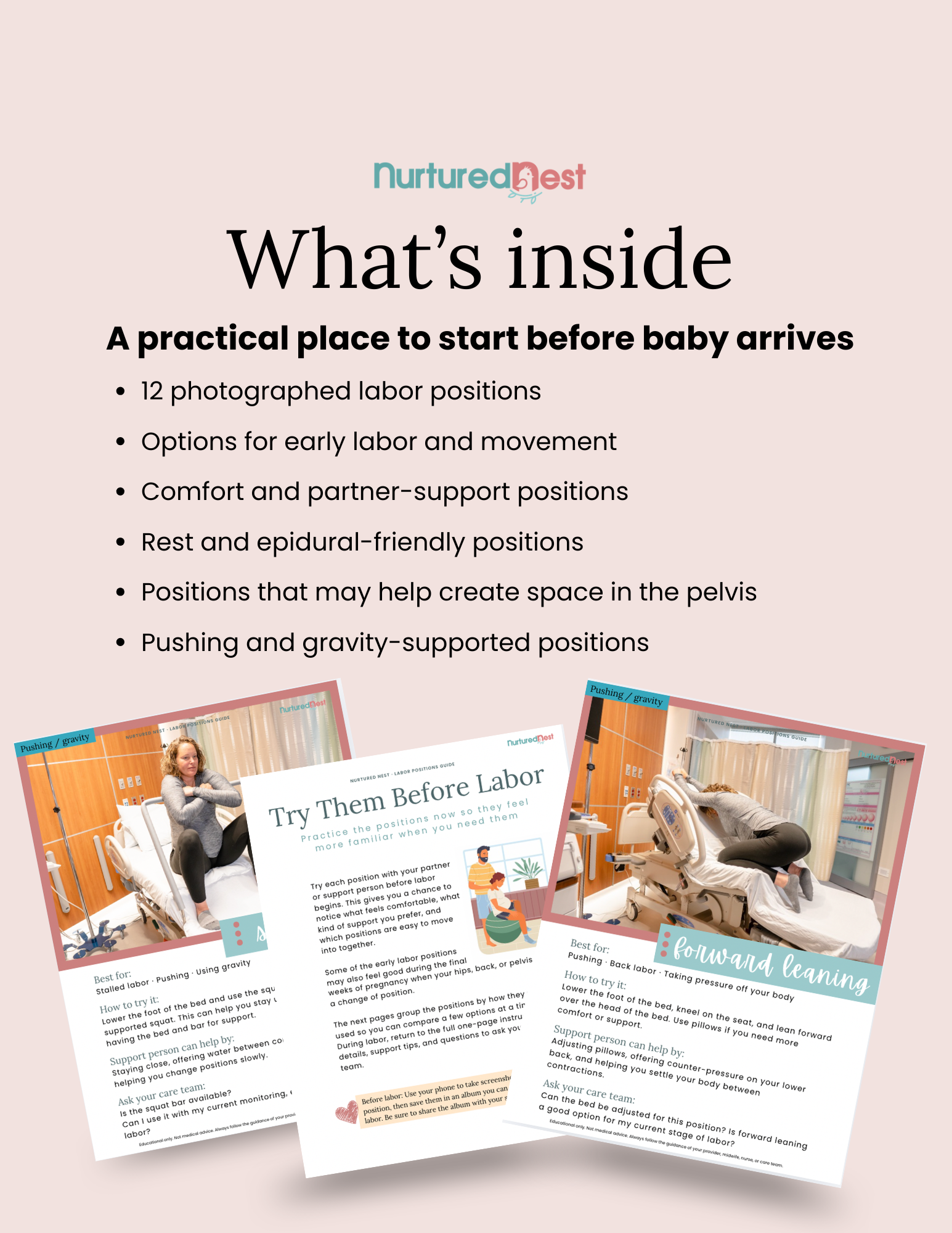
18-page digital PDF · Instant access after checkout · Share it with your partner or doula
This Article vs. the Labor Positions Guide
This article covers back labor. The guide covers the whole labor, in a format made for labor day.
| This article | Labor Positions Guide | |
|---|---|---|
| Back labor positions and counter-pressure | ✓ | ✓ |
| A photo of every position | — | ✓ |
| Positions for early labor, rest, and pushing | — | ✓ |
| Support-person steps for each position | — | ✓ |
| Questions for your care team | — | ✓ |
| Printable and phone-ready for the hospital | — | ✓ |
Ready to Prepare for All of Labor?
Positions are one tool. Knowing what's happening in your body, what your options are, and what to do if plans change is what makes them work.
From the Nurtured Nest learning platform
Like having resources like this that help you think through every part?
That's what our full Childbirth + Postpartum Program does best. Expert-led lessons cover back labor, positions and comfort measures, pain relief and epidurals, partner support, and what to do when birth doesn't go as planned — with guides and checklists built in. And when a question comes up, you can ask an educator and hear back within 24 hours.
- Partner access included
- 52 short lessons
- Questions answered in 24 hours
Before watching, I felt very underprepared and a little terrified of labor and delivery. After finishing the course, I feel way more confident and now have an arsenal of tools to help.
Back Labor FAQ
How do I know if it's back labor or normal contraction pain?
Back labor is intense pain concentrated in the lower back that often doesn't fully ease between contractions. Many people describe it as deep, grinding, or crushing pressure right at the sacrum. If back pain is the main thing you're feeling and it isn't letting up between contractions, that's likely back labor. Let your nurse or provider know.
Will these positions make my baby turn?
No position can guarantee it. Most babies who start labor facing up turn on their own. Research shows positions like hands and knees reliably help with back pain; whether they help baby turn is less clear. Some babies are born facing up, and your care team will guide you if that happens.
Can I prevent back labor before it starts?
There's no proven way. A large study found that spending time on hands and knees in late pregnancy didn't change baby's position at birth. Staying active and using positions that feel comfortable is still a good idea; it just isn't a guarantee.
Should I get an epidural if I have back labor?
That's your call, and it's not a failure if you do. Back labor can be more intense than typical labor, and an epidural can give real relief and a chance to rest. The tradeoff is less mobility, which makes position changes harder. Decide based on what you want and what your care team recommends for your situation.
How long does back labor last?
It follows your labor's timeline, which varies a lot. Some people only feel it in active labor; others have it from early labor through pushing. Positions and counter-pressure can make it much more manageable, even when they don't make labor shorter.
My partner doesn't know how to do counter-pressure. How do they learn?
Practice before labor. Lie on your side or get on all fours and have your partner find your sacrum (the flat bone at the base of your spine, between the two dimples) and press with the heel of their hand. You'll know right away when they've found the right spot. A few minutes of practice now saves a lot of guessing later. The Labor Positions Guide also shows the support person's role for every position.
Ready for labor day?
Two ways to get ready
Labor Positions Guide
For couples who want a quick, visual plan for labor day.
$9
- 12 photographed positions, including back labor
- Support-person steps for every position
- Printable and phone-ready
Childbirth + Postpartum
For couples who want to understand all of labor, not just the positions.
$199
- 52 short lessons · 5+ hours · 22 guides
- Partner access and questions answered in 24 hours
- 12 months of access
Preparing for the whole first year? See the Complete Pregnancy to Baby Bundle.
